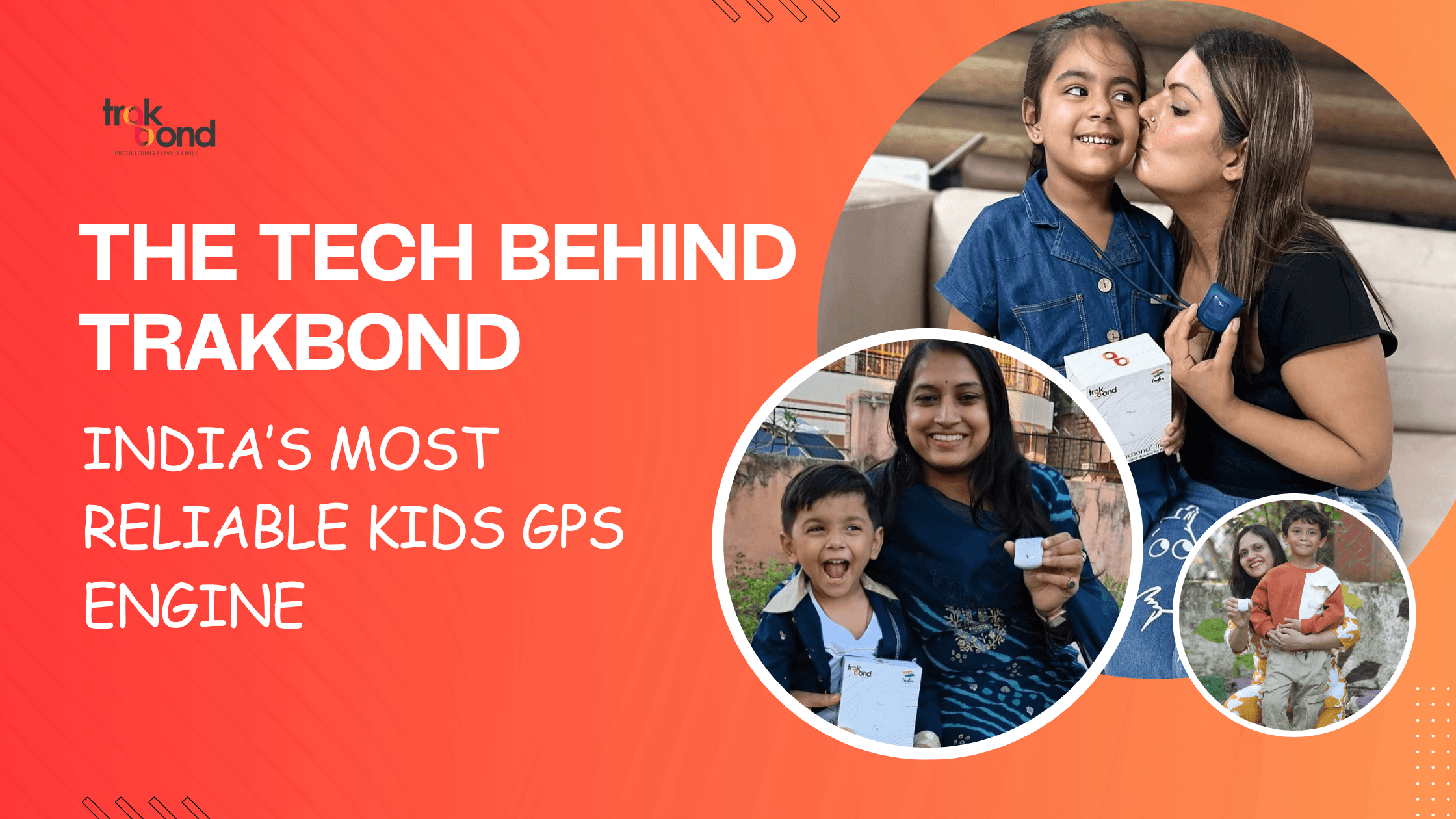
The Tech Behind Trakbond: India’s Most Reliable Kids GPS Engine
Ensuring your child’s safety is one of the most powerful motivations for modern parents — and at the heart of that peace of mind is precision location technology. Trakbond has emerged as one of India’s most trusted GPS trackers for kids, blending cutting-edge GPS fundamentals with intelligent signal fusion, real-time tracking, and smart alerting features that keep caregivers connected no matter where life takes their little ones.
This blog breaks down the tech behind Trakbond — from GPS basics to the advanced handling of signals and AI-enhanced routing — so you understand exactly how it delivers accuracy, reliability, and safety.
What Makes Trakbond Different?
Unlike many kids GPS watches that depend on Bluetooth signals or nearby phone networks, Trakbond trackers use standalone satellite navigation plus cellular connectivity — meaning they provide location updates independently and across India. The technology inside isn’t just about reading coordinates — it’s about fusing multiple data streams to give you a real-time, dependable view of your child’s location.
Core Technologies Used by Trakbond
- GPS (Global Positioning System): Connects with satellites to determine precise latitude and longitude.
- GSM/GPRS Cellular Module: Sends location data to your smartphone app over mobile networks.
- Signal Fusion & Assisted Positioning: Improves location accuracy in challenging areas (urban environments, indoors).
- Cloud Architecture: Stores and processes location data securely, letting you view history and alerts.
Together, these elements power real-time tracking with safety features like safe zones, SOS alerts, and movement timeline views — all accessible through the Trakbond mobile app.
How GPS Location Works (In Plain Terms)
Before diving deeper into Trakbond’s engine, let’s quickly recap the basics of GPS — the foundation of location tracking.
GPS Fundamentals
The Global Positioning System relies on a constellation of satellites orbiting Earth, continuously sending timestamped signals. A GPS receiver (like the one inside a Trakbond tracker) uses these signals to calculate position using a process called trilateration. By comparing signals from at least three satellites, it can pinpoint latitude and longitude; a fourth improves accuracy further.
Real-Time Tracking
In a tracking context, once the device computes its location:
- It sends coordinates via a cellular network to a cloud server.
- The server processes and pushes updates to your smartphone app in real time.
- You see your child’s route, history, and alerts instantly — like watching a live map.
This active mode is what makes Trakbond responsive and dependable every time.
AI Routing & Intelligent Signal Fusion
Accuracy isn’t just about more satellites — it’s about smarter interpretations.
What Is Signal Fusion?
Signal fusion refers to combining GPS data with auxiliary signals (like cellular and Wi-Fi positioning) to improve location precision, especially in tricky environments like urban canyons or indoors where pure GPS signals weaken. Technologies like Assisted GNSS (A-GPS) help warm up the GPS receiver faster using network data so you get fixes quickly and reliably.
Trakbond’s platform likely uses advanced versions of this fusion strategy — merging satellite data with network location and app feedback — to refine accuracy continuously.
AI & Routing Intelligence
Though specific implementation details are proprietary, modern GPS systems often leverage AI and machine learning for tasks such as:
- Predicting movement patterns
- Smoothing out location noise from weak signals
- Detecting direction changes for more accurate tracking
In broader IoT tracking research and vehicle tracking domains, AI is shown to enhance route decisioning and predictive insights by analyzing patterns rather than raw location alone.
When this kind of intelligence is layered into a kids GPS engine, it means fewer false alerts, more responsive tracking, and better performance where connectivity fluctuates.
GSM + GPS Fusion — Practical Benefits
Why Combine GPS with Cellular?
GPS gives precise global coordinates, but it struggles:
- Indoors
- Near tall buildings
- Where satellites are obstructed
Cellular (GSM/GPRS) doesn’t provide precision on its own, but it always gives a rough location based on tower triangulation and data coverage. When fused together:
✔ Faster initial position fixes
✔ Better continuity of location in weak GPS zones
✔ Seamless movement updates even in urban areas
✔ Live push notifications via data network
This dual-mode approach is what keeps Trakbond accurate and dependable almost everywhere in India.
How Trakbond’s Tech Works Together: Step-by-Step
- Satellite Sync: The GPS module locks onto satellite signals to calculate a raw location.
- Network Aid: When GPS weakens, the system falls back on GSM or Assisted GNSS data to refine that estimate.
- Transmission: Coordinates are sent via cellular data (SIM card inside Trakbond tracker) to the cloud server.
- Processing & Alerts: The server processes position, checks against safe zones, and sends alerts or updates to your app.
- Smarter Display: AI-influenced routing logic smooths out anomalies and provides the most accurate, human-friendly map view possible.
This isn’t just mapping — it’s smart location intelligence designed for safety.
Benefits of Trakbond’s GPS Engine
Pan-India coverage with pre-installed SIM — works across cities, towns, and highways.
Real-time location on mobile app — live tracking with zoomable maps.
Safe-zone (geofence) alerts — notifications when your child enters/leaves defined zones.
Timeline view — historical movement tracking helps verify routes and timelines.
SOS Panic alerts — instant help notifications from the device.
GPS + Cellular fusion — better accuracy where standalone GPS may falter.
Final Thought
With Trakbond’s advanced GPS engine combining satellite navigation, intelligent signal fusion, cloud processing, and AI-inspired strategies, parents get dependable, real-time tracking tailored to real life in India’s diverse environments. From school runs to park playtime, Trakbond keeps you connected with precision and confidence.
FAQs — Trakbond & GPS Tech
Q1. How accurate is Trakbond’s GPS location?
Accuracy under open sky with direct GPS signal can be within ~5–10 m. Indoors or around buildings, the device combines API/GSM data to maintain reasonable accuracy.
Q2. Why does the tracker sometimes update slowly indoors?
Satellite signals weaken indoors. That’s when GSM positioning and assisted fixes help, but the updates may lag slightly.
Q3. What is GSM/GPRS and why is it important?
GSM/GPRS enables mobile data and SMS communication — crucial for sending location to the cloud and to your app.
Q4. Does battery life affect tracking accuracy?
Yes — frequent updates require more power. Smart power-saving modes balance update frequency with battery life.
Q5. Can the tracker still work without cellular coverage?
It can compute location via GPS, but can’t push updates live until network coverage returns. Cellular fusion ensures live tracking in most populated areas